Picture a scenario with me, about a man devoted to his religion. An essential component of his religion is a period of worship that takes place on Sunday. Much of the man's week is centered on the upcoming worship. He spends much time discussing the focal point of his worship with friends, family, or even complete strangers. The man takes special care that his obligations are taken care of by Saturday evening so as not to interfere with the day of worship. After much anticipation, the day arrives. Long before the service commences, the man begins his preparations. The man may need to prepare food to enjoy in fellowship with other faithful worshipers as they await the beginning of worship. He arrives at the house of worship hours early for such brotherhood as well as to consecrate himself to render unreserved adoration to the focus of his worship. Finally the worship service starts, and for the new few hours the man's attention is completely absorbed with his devotion to his religion. No boredom here. In fact, the man could be described as a religious fanatic. The service ends, and the man departs the house of worship with his fellow believers. The man's worship experience engages his mind long after returning home, and he shares about it freely with others. Soon, the anticipation for next Sunday's worship begins to build.
In the above scenario, the object of the man's worship I was discussing was not God. It was football. I speak these things from personal experience, and they lead me to consider a question. What role should sports play in the life of a Christian? Now, there is nothing inherently wrong with sports. Problems arise, however, when folks start putting way too much emphasis on the simple act of a watching grown men play a game. The word "fan" to describe a devotee of sports comes from fanatic. Does such fanaticism help us seek first the kingdom of God?
My upbringing makes me very informed on this subject. As long as I can remember, my parents have been enthusiastic followers of professional baseball. Like them, I spent years devoting an incredible amount of time either watching baseball, reading about baseball, idolizing certain baseball players, and so forth. Yet, for all this baseball enthusiasm, I never once actually played baseball. Without doubt, I spent a lot more time in a given week thinking about baseball than about God. I could have told you the entire starting lineup of "my team," but I would have been clueless if you had asked me to name just one of the tribes of Israel. Based on the tens of thousands of people who typically attend a single major league baseball game, I was not alone in my devotion.
The trend only continued when I started college. At my university, football was king. On game day, the whole city came to a stand still, with almost all eyes focused on the stadium. I attended several of these games, and over time the behavior I witnessed both in the stands and outside of the stadium became increasingly alarming. For one thing, it was typical to scream insults and obscenities at not just the opposing team, but the opposing team's fans, the officials, or anyone else who provided a tempting target. In Ephesians 4:31-32, God's Word says, "Let all bitterness, and wrath, and anger, and clamour, and evil speaking, be put away from you, with all malice; and be ye kind one to another, tender-hearted, forgiving one another, even as God for Christ's sake hath forgiven you."
During games like these that I have described, with attendance figures of 80,000 thousand fans, many of the spectators can get whipped into an emotional frenzy that often results in real hatred of the other team and its fans. Folks watching the games on television can of course be caught in this unloving spirit as well. In some cases, these feelings will subside after the game's conclusion, but I know first-hand that this is not always the case. Teams with long-standing rivalries will have die-hard fans who can, in extreme instances, become violent towards one another. At the least, there is a lot of simmering bitterness, which makes it rather difficult to show the love of Christ. "If a man say, I love God, and hateth his brother, he is a liar: for he that loveth not his brother whom he hath seen, how can he love God whom he hath not seen?" (1 John 4:20).
Beyond the wrathful feelings generated by the veneration of sports, there is the utter waste of money. You are not a real fan if you do not buy your team's clothing, memorabilia, autographs, athletic equipment, trading cards... The list goes on. Then there is the money spent on the games themselves. The ticket to one football game during my college days cost approximately thirty dollars, and that does not include parking. The biggest sports fans with money to burn buy season tickets, so they can have the chance to go to every single one of their team's home games for an entire year. Such season tickets can feature price tags of thousands of dollars per person. Why do they cost so much? Professional athletes being paid salaries of millions of dollars to play a game is a significant reason. All these resources are wasted on athletic entertainment when they could have been used for the work of the kingdom of God. How many people groups have never heard the Gospel? Or what about the worldwide tragedy of child starvation? The United States is the richest nation in the world, and a large percentage of the population professes to be Christian. Do we spend more money on helping those in need or on our sports? "For where your treasure is, there will your heart be also." (Matthew 6:21).
Not only is the work of the kingdom neglected financially, it is also short-changed the gift of time. A typical professional baseball game lasts for three hours. In an entire season, each team plays approximately 80 home games. When you do the math, this means a season ticket holder could spend theoretically ten entire days doing nothing but watch millionaires throw a baseball around a field. When I was in college, I usually went to church meeting on Sunday evening. Because college students do not like to get up early, the service was typically crowded. However, on Super Bowl Sunday, the attendance would be drastically lower, so much that the minister would comment on it. The loyalty to football superseded the loyalty to the church. Why will some people spend so much time on sports while struggling to find time for Christian responsibilities? I believe the answer is that devotion to sports can be a surrogate religion for many, providing (temporary) fulfillment and purpose apart from God. It is of course one of Satan's goals to distract people from their need of a whole-hearted, obedient relationship with Christ, and he employs many deceptions to achieve this end. Is it possible that he who is transformed into an angel of light (2 Corinthians 11:14) can use something "harmless" like sports for this purpose?
I am largely able to avoid exposure to the permeation of our culture by sports since I do not watch television or follow the news. However, I still receive catalogs in the mail selling all sorts of items. In one of these catalogs, there was a shirt printed with the message, "Anyone who says money can't buy happiness never had season tickets." The product description elaborates on the "ecstasy of having season tickets to your favorite team." This is the spirit of the world. It would be wise for Christians to heed the warning of the Apostle John.
Love not the world, neither the things that are in the world. If any man love the world, the love of the Father is not in him. For all that is in the world, the lust of the flesh, and the lust of the eyes, and the pride of life, is not of the Father, but is of the world. And the world passeth away, and the lust thereof: but he that doeth the will of God abideth for ever.
(1 John 2:15-17)
To learn more about the gospel of the kingdom, please visit Scroll Publishing Co. or Shippensburg Christian Fellowship
Friday, February 1, 2013

Sunday, September 16, 2012
The Most High Ruleth in the Kingdoms of Men
In the days of King Hezekiah, Judah was invaded by Sennacherib, king
of Assyria. Sennacherib blasphemed the Lord to the people of Jerusalem
through his servants, saying that the God of Israel could not save them
any more than the gods of the other nations conquered by Assyria.
However, Hezekiah bolstered the people with these words: "Be strong and
courageous, be not afraid nor dismayed for the king of Assyria, nor for
all the multitude that is with him: for there be more with us than with
him: with him is an arm of flesh, but with us is the LORD our God to
help us, and to fight our battles. And the people rested themselves upon
the words of Hezekiah king of Judah." (2 Chronicles 32:7-8.)
Consequently, the Lord promised that Sennacherib would not shoot a
single arrow against Jerusalem. The angel of the Lord destroyed the host
of Assyria, and later the king was killed by his own sons in the house
of his god.
This is a marvelous example of God's deliverance to those who trust in the everlasting arms instead of the arm of flesh. I also believe it is a challenge to us as Christians. We can be tempted to trust the arm of flesh many ways in our daily lives. Regarding this, an area that has caused me to ponder is Christian involvement in politics. Does it glorify God for Christians to be politically active? It is my goal to answer this question in the light of God's word.
I believe consideration of this issue should begin with a foundational point of Christ's teachings: the two kingdom idea. The Gospels are full of the words of Jesus regarding the opposing natures of the kingdom of God and the kingdom of the world. Christians have been delivered from the world to the kingdom of the Son (Colossians 1:13), so you cannot be in both kingdoms. The methods by which members of each kingdom operate are diametrically opposed. Under Pilate's questioning, "Jesus answered, My kingdom is not of this world; if my kingdom were of this world, then would my servants fight, that I should not be delivered to the Jews: but now is my kingdom not from hence." (John 18:36.) I am unaware of any scriptural examples of Christ or one of his followers attempting to influence the course of the Roman government, much less taking part in it. Jesus eschewed all earthly power, whether offered by Satan (Luke 4:5-7) or the people around him. After feeding the five thousand, the crowd wanted to seize Jesus and make him a king, but Jesus fled from them (John 6:15).
We should not lose track of the concept of God's total sovereignty. All men have free will, but God has made it clear in His word that the course of the nations of the world are ultimately under His authority. One of the clearest examples of this principle is located in the fourth chapter of Daniel. Nebuchadnezzar, king of Babylon, had a vision in a dream warning him of his future chastisement for pride. The king's understanding was taken from him for his boast that he had personally built the kingdom of Babylon. Considering verse 17 reveals God's purpose: "This matter is by decree of the watchers, and the demand by the word of the holy ones: to the intent that the living may know that the Most High ruleth in the kingdom of men, and giveth it to whomsoever he will, and setteth up over it the basest of men." This verse is rich with meaning regarding the relation of the Christian to politics. I have lost track of how many times I have heard the plea that Christians should vote individuals with godlier principles into office. Assuming you could find a politician who fits this description, you still would not know if this person is God's choice. He may have a reason for bringing a wicked man to power. Consider the pharaoh who contended with Moses. The Lord revealed that He specifically raised up the pharaoh in order to demonstrate His power (Exodus 9:16). As a final point in consideration of God's sovereignty, think about Christ's response to Pilate's interrogation in John 19:11: "Jesus answered, Thou couldest have no power at all against me, except it were given thee from above: therefore he that delivered me unto thee hath the greater sin."
However, you may ask, "Why couldn't it be God's will to bring a Christian to political office for His glory?" After all, Paul said in Romans 13 that the higher powers are ordained of God, even calling them God's ministers. An important question to answer. The words translated as "minister(s)" in this passage have the basic meaning of "servant." Now, let's turn to the book of Jeremiah briefly to observe someone else the Almighty calls His servant. "Behold, I will send and take all the families of the north, saith the LORD, and Nebuchadrezzar, my servant, and will bring them against this land..." (Jeremiah 25:9.) The political authorities are "God's ministers" insomuch as they are executing the function God delegated for earthly government--whether they realize it or not.
I contend that a Christian could not hold political office without violating Biblical principles. Jesus has commanded His disciples not to take the sword (e.g., Matthew 26:52), but the government cannot keep order in society without using the sword. The political process involves fighting with your opponents to force your party's agenda. Whether in elections or while in office, politicians typically strive to make their rivals look bad while boosting their own images. How different from how Christians should behave! "Let nothing be done through strife or vainglory; but in lowliness of mind let each esteem other better than themselves." (Philippians 2:3.)
Perhaps you will say, "I could not be a politician myself, but there is nothing wrong with voting for them." When you cast a vote for a political candidate, you are endorsing his behavior and all of his political views. The teachings of Christ call for His disciples to be non-resistant (see Matthew 5:38-48). However, we cannot seriously say we are non-resistant while voting for the commander-in-chief of the army, which is one of the president's duties. Christians have been denied conscientious objector status in the past for this reason. Neither major party in the United States has a platform consistent with the words of Christ. Democrats are more likely to help the poor, but they support the murder of unborn babies. Republicans oppose abortion but support wars that bring untold death and destruction to other countries. A Christian who casts his lot with either side is making a compromise with ungodliness.
Here is the bottom line: if Christians try to reform society by political activism, they are trusting in the arm of flesh. Christ told us to seek first the kingdom of God (Matthew 6:33), so we need to keep our priorities straight. If we are not careful, we can end up like Pharisees. "Woe unto you, scribes and Pharisees, hypocrites! for ye make clean the outside of the cup and of the platter, but within they are full of extortion and excess. Thou blind Pharisee, clease first that which is within the cup and platter, that the outside of them may be clean also." (Mattew 23:25-26.) Does it make sense make sense to say we do not believe in having rigid church rules because it is legalistic, but then we campaign and vote for a law that imposes Christian morality on the masses? No law ever changed a person's heart, but the power of the Gospel can transform a sinner from the inside out. If Christians agitate for laws against abortion or homosexual marriage (to name a few hot examples), all we are trying to do is wash the outside of the cup. "For though we walk in the flesh, we do not war after the flesh: (for the weapons of our warfare are not carnal, but mighty through God to the pulling down of strongholds;) casting down imaginations and every high thing that exalteth itself against the knowledge of God, and bringing into captivity every thought to the obedience of Christ." (2 Corinthians 10:3-5.) Followers of Christ wage war against the god of this world with the Sword of the Spirit, which is the Word of God. We do not use the earthly sword of coercion, nor do we convince the state to use it on our behalf. As Jesus prayed to the Father, "Sanctify them through thy truth: thy word is truth." (John 17:17.)
If you still need convincing that Christians and politics should not mix, just look at election campaigns. I have already mentioned how rivals will smear each other's reputation. Also, so much time and money is wasted. God knows how many millions of dollars are frittered away in an attempt to get as many votes as possible. With the resources and time Christians spend on these campaigns, how many unreached peoples could be evangelized or poor people fed? The whole election process is a distraction from the work of God. When I was personally grappling with the issue of whether Christians shold be involved in politics, I moved to another county and had to fill out a new voter registration form. One of the requirements on that form was a loyalty oath to uphold the Constitution and laws of the United States. On one hand, there was an option to "affirm" instead of "swear" for those who have a conscience against swearing oaths (see Matthew 5:33-37). On the other hand, I could not even affirm this statement. If the Constitution and laws of the United States at any point violate the Scriptures, I cannot obey them. "Then Peter and the other apostles answered and said, We ought to obey God rather than men." (Acts 5:29.) The Bible instructs us to pray for our rulers (1 Timothy 2:2), not to get caught up in the ungodly frenzy of choosing them.
It is true that government officials may be elected or laws be enacted that interfere with the free exercise of the Christian faith. In that case, take heed of Paul's advice to his son in the faith: "Thou therefore endure hardness, as a good soldier of Jesus Christ. No man that warreth entangleth himself with the affairs of this life, that he may please him who hath chosen him to be a soldier." (2 Timothy 2:3-4.) And do not forget this either: "Yea, and all that will live godly in Christ Jesus shall suffer persecution." (2 Timothy 3:12.) The world, and possibly other Christians, will try valiantly to convince you that it is every citizen's duty to participate in the political process. However, "the wisdom of the world is foolishness with God. For it is written, He taketh the wise in their own craftiness." (1 Corinthians 3:19.) Thus, let us as followers of Christ remain steadfast in the simplicity of the Gospel and advance only His kingdom until He comes!
This is a marvelous example of God's deliverance to those who trust in the everlasting arms instead of the arm of flesh. I also believe it is a challenge to us as Christians. We can be tempted to trust the arm of flesh many ways in our daily lives. Regarding this, an area that has caused me to ponder is Christian involvement in politics. Does it glorify God for Christians to be politically active? It is my goal to answer this question in the light of God's word.
I believe consideration of this issue should begin with a foundational point of Christ's teachings: the two kingdom idea. The Gospels are full of the words of Jesus regarding the opposing natures of the kingdom of God and the kingdom of the world. Christians have been delivered from the world to the kingdom of the Son (Colossians 1:13), so you cannot be in both kingdoms. The methods by which members of each kingdom operate are diametrically opposed. Under Pilate's questioning, "Jesus answered, My kingdom is not of this world; if my kingdom were of this world, then would my servants fight, that I should not be delivered to the Jews: but now is my kingdom not from hence." (John 18:36.) I am unaware of any scriptural examples of Christ or one of his followers attempting to influence the course of the Roman government, much less taking part in it. Jesus eschewed all earthly power, whether offered by Satan (Luke 4:5-7) or the people around him. After feeding the five thousand, the crowd wanted to seize Jesus and make him a king, but Jesus fled from them (John 6:15).
We should not lose track of the concept of God's total sovereignty. All men have free will, but God has made it clear in His word that the course of the nations of the world are ultimately under His authority. One of the clearest examples of this principle is located in the fourth chapter of Daniel. Nebuchadnezzar, king of Babylon, had a vision in a dream warning him of his future chastisement for pride. The king's understanding was taken from him for his boast that he had personally built the kingdom of Babylon. Considering verse 17 reveals God's purpose: "This matter is by decree of the watchers, and the demand by the word of the holy ones: to the intent that the living may know that the Most High ruleth in the kingdom of men, and giveth it to whomsoever he will, and setteth up over it the basest of men." This verse is rich with meaning regarding the relation of the Christian to politics. I have lost track of how many times I have heard the plea that Christians should vote individuals with godlier principles into office. Assuming you could find a politician who fits this description, you still would not know if this person is God's choice. He may have a reason for bringing a wicked man to power. Consider the pharaoh who contended with Moses. The Lord revealed that He specifically raised up the pharaoh in order to demonstrate His power (Exodus 9:16). As a final point in consideration of God's sovereignty, think about Christ's response to Pilate's interrogation in John 19:11: "Jesus answered, Thou couldest have no power at all against me, except it were given thee from above: therefore he that delivered me unto thee hath the greater sin."
However, you may ask, "Why couldn't it be God's will to bring a Christian to political office for His glory?" After all, Paul said in Romans 13 that the higher powers are ordained of God, even calling them God's ministers. An important question to answer. The words translated as "minister(s)" in this passage have the basic meaning of "servant." Now, let's turn to the book of Jeremiah briefly to observe someone else the Almighty calls His servant. "Behold, I will send and take all the families of the north, saith the LORD, and Nebuchadrezzar, my servant, and will bring them against this land..." (Jeremiah 25:9.) The political authorities are "God's ministers" insomuch as they are executing the function God delegated for earthly government--whether they realize it or not.
I contend that a Christian could not hold political office without violating Biblical principles. Jesus has commanded His disciples not to take the sword (e.g., Matthew 26:52), but the government cannot keep order in society without using the sword. The political process involves fighting with your opponents to force your party's agenda. Whether in elections or while in office, politicians typically strive to make their rivals look bad while boosting their own images. How different from how Christians should behave! "Let nothing be done through strife or vainglory; but in lowliness of mind let each esteem other better than themselves." (Philippians 2:3.)
Perhaps you will say, "I could not be a politician myself, but there is nothing wrong with voting for them." When you cast a vote for a political candidate, you are endorsing his behavior and all of his political views. The teachings of Christ call for His disciples to be non-resistant (see Matthew 5:38-48). However, we cannot seriously say we are non-resistant while voting for the commander-in-chief of the army, which is one of the president's duties. Christians have been denied conscientious objector status in the past for this reason. Neither major party in the United States has a platform consistent with the words of Christ. Democrats are more likely to help the poor, but they support the murder of unborn babies. Republicans oppose abortion but support wars that bring untold death and destruction to other countries. A Christian who casts his lot with either side is making a compromise with ungodliness.
Here is the bottom line: if Christians try to reform society by political activism, they are trusting in the arm of flesh. Christ told us to seek first the kingdom of God (Matthew 6:33), so we need to keep our priorities straight. If we are not careful, we can end up like Pharisees. "Woe unto you, scribes and Pharisees, hypocrites! for ye make clean the outside of the cup and of the platter, but within they are full of extortion and excess. Thou blind Pharisee, clease first that which is within the cup and platter, that the outside of them may be clean also." (Mattew 23:25-26.) Does it make sense make sense to say we do not believe in having rigid church rules because it is legalistic, but then we campaign and vote for a law that imposes Christian morality on the masses? No law ever changed a person's heart, but the power of the Gospel can transform a sinner from the inside out. If Christians agitate for laws against abortion or homosexual marriage (to name a few hot examples), all we are trying to do is wash the outside of the cup. "For though we walk in the flesh, we do not war after the flesh: (for the weapons of our warfare are not carnal, but mighty through God to the pulling down of strongholds;) casting down imaginations and every high thing that exalteth itself against the knowledge of God, and bringing into captivity every thought to the obedience of Christ." (2 Corinthians 10:3-5.) Followers of Christ wage war against the god of this world with the Sword of the Spirit, which is the Word of God. We do not use the earthly sword of coercion, nor do we convince the state to use it on our behalf. As Jesus prayed to the Father, "Sanctify them through thy truth: thy word is truth." (John 17:17.)
If you still need convincing that Christians and politics should not mix, just look at election campaigns. I have already mentioned how rivals will smear each other's reputation. Also, so much time and money is wasted. God knows how many millions of dollars are frittered away in an attempt to get as many votes as possible. With the resources and time Christians spend on these campaigns, how many unreached peoples could be evangelized or poor people fed? The whole election process is a distraction from the work of God. When I was personally grappling with the issue of whether Christians shold be involved in politics, I moved to another county and had to fill out a new voter registration form. One of the requirements on that form was a loyalty oath to uphold the Constitution and laws of the United States. On one hand, there was an option to "affirm" instead of "swear" for those who have a conscience against swearing oaths (see Matthew 5:33-37). On the other hand, I could not even affirm this statement. If the Constitution and laws of the United States at any point violate the Scriptures, I cannot obey them. "Then Peter and the other apostles answered and said, We ought to obey God rather than men." (Acts 5:29.) The Bible instructs us to pray for our rulers (1 Timothy 2:2), not to get caught up in the ungodly frenzy of choosing them.
It is true that government officials may be elected or laws be enacted that interfere with the free exercise of the Christian faith. In that case, take heed of Paul's advice to his son in the faith: "Thou therefore endure hardness, as a good soldier of Jesus Christ. No man that warreth entangleth himself with the affairs of this life, that he may please him who hath chosen him to be a soldier." (2 Timothy 2:3-4.) And do not forget this either: "Yea, and all that will live godly in Christ Jesus shall suffer persecution." (2 Timothy 3:12.) The world, and possibly other Christians, will try valiantly to convince you that it is every citizen's duty to participate in the political process. However, "the wisdom of the world is foolishness with God. For it is written, He taketh the wise in their own craftiness." (1 Corinthians 3:19.) Thus, let us as followers of Christ remain steadfast in the simplicity of the Gospel and advance only His kingdom until He comes!
Tuesday, December 20, 2011
The Basis for Christian Morality
The Old Testament fills a number of important roles. For one, the fulfillment of Old Testament prophecies by Jesus authenticate His identity as the Messiah. Also, the apostle Paul writes that the failures of the children of Israel "...were our examples, to the intent we should not lust after evil things, as they also lusted." (1 Cor. 10:6). Other significant factors could be pointed out as well. However, the question I want to ask is, does Old Testament morality still apply to Christians?
When I refer to Old Testament morality, I am primarily talking about the Mosaic law. Do some or all of the commandments that the Lord gave to Moses still have validity in the Christian's life? One of the important Scripture passages concerning this subject is in the Sermon on the Mount.
"Think not that I am come to destroy the law, or the prophets: I am not come to destroy, but to fulfil. For verily I say unto you, Till heaven and earth pass, one jot or one tittle shall in no wise pass from the law, till all be fulfilled."
Matthew 5:17-18
What is Jesus saying here? One view would be that since Christ was not destroying the law, it is to some extent still applicable. Now, Christians obviously do not observe aspects of the law regarding, for example, animal sacrifices. Christ's atonement has made those sacrifices obsolete. In response, some students of the Bible have introduced the concept of the division of the Mosaic law into different categories. While there are some variations on this theme, the basic idea is that the commandments in the old law can be categorized as moral or ceremonial. The former category is still in place for Christian, and the latter is not. Hence the big emphasis placed on the Ten Commandments, which are classified "moral."
On the other hand, I subscribe to the opposing view. Namely, Christ's life and atoning sacrifice have fulfilled the law, and as such the law has passed away entirely. Fulfilling the law did not destroy it but rather made it unnecessary. Let's consider a few Scriptures that support this view.
"But now hath he obtained a more excellent ministry, by how much also he is the mediator of a better covenant, which was established upon better promises. For if that first covenant had been faultless, then should no place have been sought for the second...In that he saith, A new covenant, he hath made the first old. Now that which decayeth and waxeth old is ready to vanish away."
Heb. 8:6-7, 13
"Then said he, Lo, I come to do thy will, O God. He taketh away the first, that he may establish the second. By the which will we are sanctified through the offering of the body of Jesus Christ once for all."
Heb. 10:9-10
The bottom line that we are dealing with here, I believe, is disagreement over how a believer in Christ is sanctified. It is my view that sanctification does not come through observing Old Covenant moral codes. The believer under the New Covenant is guided by the Holy Spirit in concord with the New Testament scriptures. Jesus told His disciples that the Holy Spirit would guide them into all truth. (John 16:13)
"Wherefore the law was our schoolmaster to bring us unto Christ, that we might be justified by faith. But after that faith is come, we are no longer under a schoolmaster."
Gal. 3:24-25
What about the supposed moral vs. ceremonial dichotomy in the Mosaic law? Honestly, I
believe this idea is without Biblical basis. For one thing, how is the Christian to know for sure if a Mosaic commandment is moral or ceremonial? Consider the Ten Commandments, which would be typically viewed as the moral foundation of the law of Moses. "Thou shalt not steal" or "thou shalt not kill" are obviously moral in nature. However, what about keeping the sabbath? Is that command moral, ceremonial, or both?
Here's another point to consider. If God intended this division of the old law, it makes sense that the commandments would be organized by category so Christians would not be confued as to which commandments to follow. For a case study of this idea, I would like to turn to Leviticus 19. Verse 18 states: "Thou shalt not avenge, nor bear any grudge against the children of thy people, but thou shalt love thy neighbour as thyself: I am the LORD." This principle would seem clearly moral in nature. Using the above logic, the other verses in this passage should also describe moral commands. With that in mind, let's look at verse 19: "Ye shall keep my statutes. Thou shalt not let thy cattle gender with a diverse kind: thou shalt not sow thy field with mingled seed: neither shall a garment mingled of linen and woollen come upon thee." Now, this command seems to be ceremonial. So, we have a moral rule and a ceremonial rule in consecutive verses! God is not the author of confusion (1 Cor. 14:33).
The New Covenant requires a higher moral standard than the Old. The reason I say this is because the Old Covenant regulated behavior, while the New Covenant is more concerned with the inward disposition (which of course affects behavior). For instance, in the law of Moses, the Lord forbid the act of adultery. However, in the Sermon on the Mount, Jesus said just looking at a women with lust constitutes adultery (Matthew 5:27-28). In other words, observation of the Mosaic law would potentially clean the outside of the cup while leaving the inside full of wickedness. Just following the Ten Commandments is not sufficient.
Confusion regarding the relationship between the two Testaments has caused great tragedy in the history of Christianity. Christ said, "Love your enemies, do good to them which hate you, bless them that curse you, and pray for them which despitefully use you." (Luke 6:27-28). Despite these words and many more like them in the New Testament, professing Christians regularly fight in wars or even persecute other professing Christians with different beliefs.
Using the sword in the name of Christ is forbidden to believers. Nevertheless, ever since the time of Emperor Constantine, bloodshed in the name of Christ has been justified on the basis of the wars of the Old Testament. It was the same Constantine who was responsible for the fusion of the state and institutional church. Similarly, this concept is rationalized based on the theocratic nation of Israel in the Old Covenant, even though the church-state union violates New Covenant principles.
"But Jesus called them to him, and saith unto them, Ye know that they which are accounted to rule over the Gentiles exercise lordship over them; and their great ones exercise authority upon them. But so shall it not be among you: but whosoever will be great among you, shall be your minister: And whosoever of you will be the chiefest, shall be servant of all."
Mark 10:42-44
Much more could be said on the subjects of non-resistance and the separation of church of state. For the purposes of the matter at hand, they serve to demonstrate the importance of placing the New Testament in its proper place as a superior moral standard compared to the Old Testament. "Wherefore, my brethren, ye also are become dead to the law by the body of Christ; that ye should be married to another, even to him who is raised from the dead, that we should bring forth fruit unto God." (Romans 7:4). The conclusion of the matter is: we do not follow the law of Moses. We only follow Christ.
When I refer to Old Testament morality, I am primarily talking about the Mosaic law. Do some or all of the commandments that the Lord gave to Moses still have validity in the Christian's life? One of the important Scripture passages concerning this subject is in the Sermon on the Mount.
"Think not that I am come to destroy the law, or the prophets: I am not come to destroy, but to fulfil. For verily I say unto you, Till heaven and earth pass, one jot or one tittle shall in no wise pass from the law, till all be fulfilled."
Matthew 5:17-18
What is Jesus saying here? One view would be that since Christ was not destroying the law, it is to some extent still applicable. Now, Christians obviously do not observe aspects of the law regarding, for example, animal sacrifices. Christ's atonement has made those sacrifices obsolete. In response, some students of the Bible have introduced the concept of the division of the Mosaic law into different categories. While there are some variations on this theme, the basic idea is that the commandments in the old law can be categorized as moral or ceremonial. The former category is still in place for Christian, and the latter is not. Hence the big emphasis placed on the Ten Commandments, which are classified "moral."
On the other hand, I subscribe to the opposing view. Namely, Christ's life and atoning sacrifice have fulfilled the law, and as such the law has passed away entirely. Fulfilling the law did not destroy it but rather made it unnecessary. Let's consider a few Scriptures that support this view.
"But now hath he obtained a more excellent ministry, by how much also he is the mediator of a better covenant, which was established upon better promises. For if that first covenant had been faultless, then should no place have been sought for the second...In that he saith, A new covenant, he hath made the first old. Now that which decayeth and waxeth old is ready to vanish away."
Heb. 8:6-7, 13
"Then said he, Lo, I come to do thy will, O God. He taketh away the first, that he may establish the second. By the which will we are sanctified through the offering of the body of Jesus Christ once for all."
Heb. 10:9-10
The bottom line that we are dealing with here, I believe, is disagreement over how a believer in Christ is sanctified. It is my view that sanctification does not come through observing Old Covenant moral codes. The believer under the New Covenant is guided by the Holy Spirit in concord with the New Testament scriptures. Jesus told His disciples that the Holy Spirit would guide them into all truth. (John 16:13)
"Wherefore the law was our schoolmaster to bring us unto Christ, that we might be justified by faith. But after that faith is come, we are no longer under a schoolmaster."
Gal. 3:24-25
What about the supposed moral vs. ceremonial dichotomy in the Mosaic law? Honestly, I
believe this idea is without Biblical basis. For one thing, how is the Christian to know for sure if a Mosaic commandment is moral or ceremonial? Consider the Ten Commandments, which would be typically viewed as the moral foundation of the law of Moses. "Thou shalt not steal" or "thou shalt not kill" are obviously moral in nature. However, what about keeping the sabbath? Is that command moral, ceremonial, or both?
Here's another point to consider. If God intended this division of the old law, it makes sense that the commandments would be organized by category so Christians would not be confued as to which commandments to follow. For a case study of this idea, I would like to turn to Leviticus 19. Verse 18 states: "Thou shalt not avenge, nor bear any grudge against the children of thy people, but thou shalt love thy neighbour as thyself: I am the LORD." This principle would seem clearly moral in nature. Using the above logic, the other verses in this passage should also describe moral commands. With that in mind, let's look at verse 19: "Ye shall keep my statutes. Thou shalt not let thy cattle gender with a diverse kind: thou shalt not sow thy field with mingled seed: neither shall a garment mingled of linen and woollen come upon thee." Now, this command seems to be ceremonial. So, we have a moral rule and a ceremonial rule in consecutive verses! God is not the author of confusion (1 Cor. 14:33).
The New Covenant requires a higher moral standard than the Old. The reason I say this is because the Old Covenant regulated behavior, while the New Covenant is more concerned with the inward disposition (which of course affects behavior). For instance, in the law of Moses, the Lord forbid the act of adultery. However, in the Sermon on the Mount, Jesus said just looking at a women with lust constitutes adultery (Matthew 5:27-28). In other words, observation of the Mosaic law would potentially clean the outside of the cup while leaving the inside full of wickedness. Just following the Ten Commandments is not sufficient.
Confusion regarding the relationship between the two Testaments has caused great tragedy in the history of Christianity. Christ said, "Love your enemies, do good to them which hate you, bless them that curse you, and pray for them which despitefully use you." (Luke 6:27-28). Despite these words and many more like them in the New Testament, professing Christians regularly fight in wars or even persecute other professing Christians with different beliefs.
Using the sword in the name of Christ is forbidden to believers. Nevertheless, ever since the time of Emperor Constantine, bloodshed in the name of Christ has been justified on the basis of the wars of the Old Testament. It was the same Constantine who was responsible for the fusion of the state and institutional church. Similarly, this concept is rationalized based on the theocratic nation of Israel in the Old Covenant, even though the church-state union violates New Covenant principles.
"But Jesus called them to him, and saith unto them, Ye know that they which are accounted to rule over the Gentiles exercise lordship over them; and their great ones exercise authority upon them. But so shall it not be among you: but whosoever will be great among you, shall be your minister: And whosoever of you will be the chiefest, shall be servant of all."
Mark 10:42-44
Much more could be said on the subjects of non-resistance and the separation of church of state. For the purposes of the matter at hand, they serve to demonstrate the importance of placing the New Testament in its proper place as a superior moral standard compared to the Old Testament. "Wherefore, my brethren, ye also are become dead to the law by the body of Christ; that ye should be married to another, even to him who is raised from the dead, that we should bring forth fruit unto God." (Romans 7:4). The conclusion of the matter is: we do not follow the law of Moses. We only follow Christ.
Sunday, September 4, 2011
Inspiration of the Bible
The concept of the inspiration of the Bible has been the source of much debate in modern times. Recently, I have been doing a small study of this subject. Specifically, I have looked at what the Scriptures say about their own nature and the resulting implications for Biblical inspiration.
I'll start with one of the most obvious verses, 2 Timothy 3:16, in which Paul says, "All scripture is given by inspiration of God, and is profitable for doctrine, for reproof, for correction, for instruction in righteousness:" I have read that some other translations render this verse as "all scripture is God-breathed." This idea could be reminiscent of God breathing into Adam the breath of life in Genesis 2:7. Peter also weighs in on this subject: "For the prophecy came not in old time by the will of man: but holy men of God spake as they were moved by the Holy Ghost." (2 Peter 1:21). Peter is clearly referring to the Old Testament here. Also, Paul's reference to "all scripture" is usually interpreted to mean just the Old Testament, since the New Testament had yet to be compiled at the time of his writing.
So, what is the evidence for the inspiration of the New Testament? I have a few examples to consider. Speaking to Timothy again, Paul writes, "For the scripture saith, Thou shalt not muzzle the ox that treadeth out the corn. And, The labourer is worthy of his reward." (1 Timothy 5:18). Here the apostle mentions two references that he refers to as scripture. The first is from Deuteronomy 25:4. However, the second is from the teachings of Jesus in the Gospels, namely Matthew 10:10 and Luke 10:7. Now, let's return to Peter, who speaks of his brother Paul. "As also in all his epistles, speaking in them of these things; in which are some things hard to be understood, which they that are unlearned and unstable wrest, as they do also the other scriptures, unto their own destruction." (2 Peter 3:16). The idea I want to pull out of this verse is that Peter identifies the writings of Paul as scripture. Moreover, the apostle John claims at the conclusion of Revelation that any man who takes away from the book forfeits his eternal life (22:19). This claim could only be valid if John believed he was writing scripture.
Just these few examples would account for the inspiration of the majority of the New Testament. However, Paul appears to claim in 1 Corinthians 7 that not all of his writings are inspired. In verse 10 he writes, "And unto the married I command, yet not I, but the Lord..." By contrast, he writes in verse 12, "But to the rest speak I, not the Lord..." Does this contradict the point I made in the previous paragraph? Allow me to explain why I think the answer is no. Here is more of the passage under discussion:
And unto the married I command, yet not I, but the Lord, Let not the wife depart from her husband: But and if she depart, let her remain unmarried, or be reconciled to her husband: and let not the husband put away his wife. But to the rest speak I, not the Lord: If any brother hath a wife that believeth not, and she be pleased to dwell with him, let him not put her away. And the woman which hath an husband that believeth not, and if he be pleased to dwell with her, let her not leave him.
(1 Corinthians 7:10-13)
When Paul refers to what the Lord commands, he is talking about teachings that Jesus gave during His ministry. Christ repeatedly spoke against divorce; see, for example, Mark 10:11-12 and Luke 16:18. On the other hand, when we get to verse 12, Paul is discussing an idea that Jesus did not directly address. So, when Paul says that he is speaking instead of the Lord, he is simply distinguishing between something that came straight from Christ's mouth and something he was inspired to write. After all, later in the same letter, Paul asserts, "If any man think himself to be a prophet, or spiritual, let him acknowledge that the things that I write unto you are the commandments of the Lord." (14:37). Furthermore, the apostle indicates elsewhere, "But I certify you, brethren, that the gospel which was preached of me is not after man. For I neither received it of man, neither was I taught it, but by the revelation of Jesus Christ." (Galatians 1:11-12).
Another interesting concept that I looked at what the Bible says about the relationship between God and the scriptures. In particular, there are some thought-provoking ideas presented by some New Testament verses that make Old Testament references. In Psalm 16, which is a "Michtam of David," the king writes, "For thou wilt not leave my soul in hell; neither wilt thou suffer thine Holy One to see corruption." (v. 10). In one of his evangelistic sermons, Paul quotes a number of Old Testament prophecies, including this psalm. "Wherefore he saith also in another psalm, Thou shalt not suffer thine Holy One to see corruption." (Acts 13:35). The antecedent of "he" in this verse is God (see v. 33). Psalm 16 was actually writted down by David, but Paul says it was spoken by God. Similarly, the believers in Jerusalem quote Psalm 2:1 when they pray, "Who by the mouth of thy servant David hast said, Why did the heathen rage, and the people imagine vain things?" (Acts 4:25)
.
There are other examples that seem to directly associate the scriptures with God. In Exodus 9:16, the Lord explains to Moses and Aaron the message they are to bring to Pharoah from Him. Paul references the incident in this way: "For the scripture saith unto Pharaoh, Even for this same purpose have I raised thee up, that I might shew my power in thee, and that my name might be declared throughout all the earth." (Romans 9:17). So, what scripture says is equated with what God says. Even more striking is the reference to God's promise (Genesis 12:3) made in Galatians 3:8. "And the scripture, foreseeing that God would justify the heathen through faith, preached before the gospel unto Abraham, saying, In thee shall all nations be blessed." Did you know the scripture preached? I hadn't noticed that before. This seems to indicate the scriptures are like a living thing. Given these examples, it would be a hard thing to separate the scriptures from God.
This study has been informative for me. Not only are concepts like atheism and agnosticism prevalent in our society, but even many segments of the professing church commonly assail the inspiration of the Bible. Consequently, the Bible becomes increasingly irrelevant as a standard of Christian living. It is my prayer that we believers who are opposed to this trend are prepard to defend the authority of the scriptures. "For the word of God is quick, and powerful, and sharper than any twoedged sword, piercing even to the dividing asunder of soul and spirit, and of the joints and marrow, and is a discerner of the thoughts and intents of the heart." (Hebrews 4:12).
I'll start with one of the most obvious verses, 2 Timothy 3:16, in which Paul says, "All scripture is given by inspiration of God, and is profitable for doctrine, for reproof, for correction, for instruction in righteousness:" I have read that some other translations render this verse as "all scripture is God-breathed." This idea could be reminiscent of God breathing into Adam the breath of life in Genesis 2:7. Peter also weighs in on this subject: "For the prophecy came not in old time by the will of man: but holy men of God spake as they were moved by the Holy Ghost." (2 Peter 1:21). Peter is clearly referring to the Old Testament here. Also, Paul's reference to "all scripture" is usually interpreted to mean just the Old Testament, since the New Testament had yet to be compiled at the time of his writing.
So, what is the evidence for the inspiration of the New Testament? I have a few examples to consider. Speaking to Timothy again, Paul writes, "For the scripture saith, Thou shalt not muzzle the ox that treadeth out the corn. And, The labourer is worthy of his reward." (1 Timothy 5:18). Here the apostle mentions two references that he refers to as scripture. The first is from Deuteronomy 25:4. However, the second is from the teachings of Jesus in the Gospels, namely Matthew 10:10 and Luke 10:7. Now, let's return to Peter, who speaks of his brother Paul. "As also in all his epistles, speaking in them of these things; in which are some things hard to be understood, which they that are unlearned and unstable wrest, as they do also the other scriptures, unto their own destruction." (2 Peter 3:16). The idea I want to pull out of this verse is that Peter identifies the writings of Paul as scripture. Moreover, the apostle John claims at the conclusion of Revelation that any man who takes away from the book forfeits his eternal life (22:19). This claim could only be valid if John believed he was writing scripture.
Just these few examples would account for the inspiration of the majority of the New Testament. However, Paul appears to claim in 1 Corinthians 7 that not all of his writings are inspired. In verse 10 he writes, "And unto the married I command, yet not I, but the Lord..." By contrast, he writes in verse 12, "But to the rest speak I, not the Lord..." Does this contradict the point I made in the previous paragraph? Allow me to explain why I think the answer is no. Here is more of the passage under discussion:
And unto the married I command, yet not I, but the Lord, Let not the wife depart from her husband: But and if she depart, let her remain unmarried, or be reconciled to her husband: and let not the husband put away his wife. But to the rest speak I, not the Lord: If any brother hath a wife that believeth not, and she be pleased to dwell with him, let him not put her away. And the woman which hath an husband that believeth not, and if he be pleased to dwell with her, let her not leave him.
(1 Corinthians 7:10-13)
When Paul refers to what the Lord commands, he is talking about teachings that Jesus gave during His ministry. Christ repeatedly spoke against divorce; see, for example, Mark 10:11-12 and Luke 16:18. On the other hand, when we get to verse 12, Paul is discussing an idea that Jesus did not directly address. So, when Paul says that he is speaking instead of the Lord, he is simply distinguishing between something that came straight from Christ's mouth and something he was inspired to write. After all, later in the same letter, Paul asserts, "If any man think himself to be a prophet, or spiritual, let him acknowledge that the things that I write unto you are the commandments of the Lord." (14:37). Furthermore, the apostle indicates elsewhere, "But I certify you, brethren, that the gospel which was preached of me is not after man. For I neither received it of man, neither was I taught it, but by the revelation of Jesus Christ." (Galatians 1:11-12).
Another interesting concept that I looked at what the Bible says about the relationship between God and the scriptures. In particular, there are some thought-provoking ideas presented by some New Testament verses that make Old Testament references. In Psalm 16, which is a "Michtam of David," the king writes, "For thou wilt not leave my soul in hell; neither wilt thou suffer thine Holy One to see corruption." (v. 10). In one of his evangelistic sermons, Paul quotes a number of Old Testament prophecies, including this psalm. "Wherefore he saith also in another psalm, Thou shalt not suffer thine Holy One to see corruption." (Acts 13:35). The antecedent of "he" in this verse is God (see v. 33). Psalm 16 was actually writted down by David, but Paul says it was spoken by God. Similarly, the believers in Jerusalem quote Psalm 2:1 when they pray, "Who by the mouth of thy servant David hast said, Why did the heathen rage, and the people imagine vain things?" (Acts 4:25)
.
There are other examples that seem to directly associate the scriptures with God. In Exodus 9:16, the Lord explains to Moses and Aaron the message they are to bring to Pharoah from Him. Paul references the incident in this way: "For the scripture saith unto Pharaoh, Even for this same purpose have I raised thee up, that I might shew my power in thee, and that my name might be declared throughout all the earth." (Romans 9:17). So, what scripture says is equated with what God says. Even more striking is the reference to God's promise (Genesis 12:3) made in Galatians 3:8. "And the scripture, foreseeing that God would justify the heathen through faith, preached before the gospel unto Abraham, saying, In thee shall all nations be blessed." Did you know the scripture preached? I hadn't noticed that before. This seems to indicate the scriptures are like a living thing. Given these examples, it would be a hard thing to separate the scriptures from God.
This study has been informative for me. Not only are concepts like atheism and agnosticism prevalent in our society, but even many segments of the professing church commonly assail the inspiration of the Bible. Consequently, the Bible becomes increasingly irrelevant as a standard of Christian living. It is my prayer that we believers who are opposed to this trend are prepard to defend the authority of the scriptures. "For the word of God is quick, and powerful, and sharper than any twoedged sword, piercing even to the dividing asunder of soul and spirit, and of the joints and marrow, and is a discerner of the thoughts and intents of the heart." (Hebrews 4:12).
Thursday, July 14, 2011
Loving Your Enemies
Ahaziah, the king of Israel, was sick. The prophet Elijah declared the Word of the Lord: because of the king's idolatry, he would not recover from his illness. Ahaziah sent three groups of soldiers in turn to fetch Elijah. In response, the prophet called down fire from heaven that consumed the first two groups. The captain of the third group begged for mercy, and he and his men received it (2 Kings 1). Now, let's move forward to the time of Christ. On their way to Jerusalem, Jesus and His disciples had to pass through a Samaritan village. Since Jews and Samaritans did not get along with each other, Jesus was not welcomed by the Samaritans. "And when his disciples James and John saw this, they said, Lord, wilt thou that we command fire to come down from heaven, and consume them, even as Elias did?" (Luke 9:54). From an Old Testament perspective, this was a reasonable question. However, the Lord's response was quite different. "But he turned, and rebuked them, and said, Ye know not what manner of spirit ye are of. For the Son of man is not come to destroy men's lives, but to save them. And they went to another village." (Luke 9:55-6).
Despite all their time at the Master's side, the apostles had yet to fully grasp the nature of the new kingdom that Christ was introducting. The earthly kingdom of Israel had used the sword in defense of its interests, just like the heathen nations surrounding it did. However, creating another earthly kingdom was not Jesus's plan; He was introducting something totally new. When Pilate questioned Him about His kingdom, "Jesus answered, My kingdom is not of this world: if my kingdom were of this world, then would my servants fight, that I should not be delivered to the Jews: but now is my kingdom not from hence." (John 18:36). This is the kingdom of God, which operates with fundamentally different rules than the kingdoms of the world. An obvious example of this is how citizens of the two kingdoms treat their enemies. In the Sermon on the Mount, Jesus explained how His followers should respond to those who oppose them.
"Ye have heard that it hath been said, An eye for an eye, and a tooth for a tooth: But I say unto you, That ye resist not evil: but whosoever shall smite thee on thy right cheek, turn to him the other also. And if any man will sue thee at the law, and take away thy coat, let him have thy cloke also. And whosoever shall compel thee to go a mile, go with him twain. Give to him that asketh thee, and from him that would borrow of thee turn not thou away. Ye have heard that it hath been said, Thou shalt love thy neighbour, and hate thine enemy. But I say unto you, Love your enemies, bless them that curse you, do good to them that hate you, and pray for them which despitefully use you, and persecute you; That ye may be the children of your Father which is in heaven: for he maketh his sun to rise on the evil and on the good, and sendeth rain on the just and on the unjust."
(Matthew 5:38-45)
Here, Christ quoted from the Law of Moses and then explained how His disciples are to follow a higher standard. This is the new spirit that James and John did not understand during the encounter with the Samaritans. Sadly, many professing Christians in the present day still do not understand this spirit. It is the mission of the Body of Christ to win lost souls to the Lord. However, this mission is harder to accomplish when Christians are not turning the other cheek to those who resist them. Paul wrote:
"Recompense to no man evil for evil. Provide things honest in the sight of all men. If it be possible, as much as lieth in you, live peaceably with all men. Dearly beloved, avenge not yourselves, but rather give place unto wrath: for it is written, Vengeance is mine; I will repay, saith the Lord. Therefore if thine enemy hunger, feed him; if he thirst, give him drink: for in so doing thou shalt heap coals of fire on his head. Be not overcome of evil, but overcome evil with good."
(Romans 12:17-21)
If someone attacks me, and I fight back, I may well save my life. But what about the attacker's soul? I thank my pastor for explaining the situation in the following light. If in the process of defending myself I kill my attacker, I have just sent an unbeliever to his grave without Christ. On the other hand, I have peace with God, so my death would mean I go to be with the Lord. Also, this would give the attacker more opportunities to repent and be saved. Now, I realize that in most similar situations these are not the only two options. There's nothing wrong with fleeing for your life, given the chance. However, as Jesus said, "For whosoever will save his life shall lose it; but whosoever shall lose his life for my sake and the gospel's, the same shall save it." (Mark 8:35).
Now, let's tackle some more controversial applications to Christ's teaching on loving your enemies. Although born-again Christians have been transported into the kingdom of God (Colossians 1:13), they still physically reside in one of the kingdoms of this world. How should Christians respond to the demands of these two kingdoms? Immediately following the passage from Romans 12 I quoted above regarding the duties of believers, there is a discussion in Chapter 13 that outlines the duties of governments. Note the sharp distinctions between them. God has ordered earthly governments to maintain order in society, and to do this the governments have to use the sword. Is it wrong for a government to use force in this way? No, it is part of the authority granted to the government by God. The next question: is it right for a Christian to use the sword under the direction of his earthly rulers? I believe the answer to this question is an emphatic NO! If you kill an unbeliever on some foreign battlefield, this person goes to a Christ-less grave just the same as if you kill an unbeliever who tried to rob you as you were walking to your car. The Bible tells us, "We ought to obey God rather than men." (Acts 5:29). The Christian's obligation to be a law-abiding citizen ends when his nation asks him disobey Christ's commands. The primary allegiance should always be to the kingdom of God.
Furthermore, loving your enemies applies to more than just life-or-death situations. It is part of everyday Christian life. Jesus did not return evil for evil, whether it be physical violence, verbal abuse, or anything else (1 Peter 2:23). If we seek to get back at people who have wronged us, how are we different from the world? And how would the world see a benefit in coming to Christ? Instead, be gracious to the person who has wronged you, thus heaping coals of fire on this person's head. In other words, show the power of Christ to transform a sinner from the inside out by displaying love in response to a slap on the cheek. "Not rendering evil for evil, or railing for railing: but contrariwise blessing; knowing that ye are thereunto called, that ye should inherit a blessing." (1 Peter 3:9).
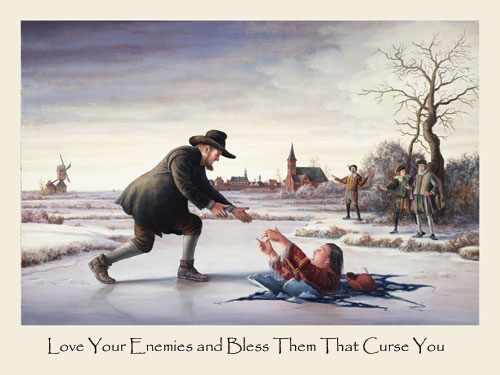
Will practicing all of this be easy? Of course not. Believe me, I have had my share of failures. But, through the grace of God, it is possible. I will close with just one example of a believer who lived out these principles. In 1569, a man by the name of Dirk Willems was arrested in Holland. His crime? He was an Anabaptist Christian, which was a transgression deserving of death according to the state church. At one point, Dirk escaped from prison, but a thief-catcher was in hot pursuit. In the process, Dirk safely crossed a frozen pond, but the thief-catcher fell through the ice. This would seem like a perfect chance for Dirk to escape. However, Dirk Willems loved his enemy more than his own life. He turned around and pulled that thief-catcher out of the freezing water, saving his life. (This heroic event is depicted in the picture at the top of this page.) Consequently, Dirk was rearrested, and he was burned at the stake when he would not compromise his faith in Christ. This story has long been a challenge to me in my Christian walk. I hope that it may be for you as well. Let us walk according to the Lord's words in Matthew 10:16--"Behold, I send you forth as sheep in the midst of wolves: be ye therefore wise as serpents, and harmless as doves."
Despite all their time at the Master's side, the apostles had yet to fully grasp the nature of the new kingdom that Christ was introducting. The earthly kingdom of Israel had used the sword in defense of its interests, just like the heathen nations surrounding it did. However, creating another earthly kingdom was not Jesus's plan; He was introducting something totally new. When Pilate questioned Him about His kingdom, "Jesus answered, My kingdom is not of this world: if my kingdom were of this world, then would my servants fight, that I should not be delivered to the Jews: but now is my kingdom not from hence." (John 18:36). This is the kingdom of God, which operates with fundamentally different rules than the kingdoms of the world. An obvious example of this is how citizens of the two kingdoms treat their enemies. In the Sermon on the Mount, Jesus explained how His followers should respond to those who oppose them.
"Ye have heard that it hath been said, An eye for an eye, and a tooth for a tooth: But I say unto you, That ye resist not evil: but whosoever shall smite thee on thy right cheek, turn to him the other also. And if any man will sue thee at the law, and take away thy coat, let him have thy cloke also. And whosoever shall compel thee to go a mile, go with him twain. Give to him that asketh thee, and from him that would borrow of thee turn not thou away. Ye have heard that it hath been said, Thou shalt love thy neighbour, and hate thine enemy. But I say unto you, Love your enemies, bless them that curse you, do good to them that hate you, and pray for them which despitefully use you, and persecute you; That ye may be the children of your Father which is in heaven: for he maketh his sun to rise on the evil and on the good, and sendeth rain on the just and on the unjust."
(Matthew 5:38-45)
Here, Christ quoted from the Law of Moses and then explained how His disciples are to follow a higher standard. This is the new spirit that James and John did not understand during the encounter with the Samaritans. Sadly, many professing Christians in the present day still do not understand this spirit. It is the mission of the Body of Christ to win lost souls to the Lord. However, this mission is harder to accomplish when Christians are not turning the other cheek to those who resist them. Paul wrote:
"Recompense to no man evil for evil. Provide things honest in the sight of all men. If it be possible, as much as lieth in you, live peaceably with all men. Dearly beloved, avenge not yourselves, but rather give place unto wrath: for it is written, Vengeance is mine; I will repay, saith the Lord. Therefore if thine enemy hunger, feed him; if he thirst, give him drink: for in so doing thou shalt heap coals of fire on his head. Be not overcome of evil, but overcome evil with good."
(Romans 12:17-21)
If someone attacks me, and I fight back, I may well save my life. But what about the attacker's soul? I thank my pastor for explaining the situation in the following light. If in the process of defending myself I kill my attacker, I have just sent an unbeliever to his grave without Christ. On the other hand, I have peace with God, so my death would mean I go to be with the Lord. Also, this would give the attacker more opportunities to repent and be saved. Now, I realize that in most similar situations these are not the only two options. There's nothing wrong with fleeing for your life, given the chance. However, as Jesus said, "For whosoever will save his life shall lose it; but whosoever shall lose his life for my sake and the gospel's, the same shall save it." (Mark 8:35).
Now, let's tackle some more controversial applications to Christ's teaching on loving your enemies. Although born-again Christians have been transported into the kingdom of God (Colossians 1:13), they still physically reside in one of the kingdoms of this world. How should Christians respond to the demands of these two kingdoms? Immediately following the passage from Romans 12 I quoted above regarding the duties of believers, there is a discussion in Chapter 13 that outlines the duties of governments. Note the sharp distinctions between them. God has ordered earthly governments to maintain order in society, and to do this the governments have to use the sword. Is it wrong for a government to use force in this way? No, it is part of the authority granted to the government by God. The next question: is it right for a Christian to use the sword under the direction of his earthly rulers? I believe the answer to this question is an emphatic NO! If you kill an unbeliever on some foreign battlefield, this person goes to a Christ-less grave just the same as if you kill an unbeliever who tried to rob you as you were walking to your car. The Bible tells us, "We ought to obey God rather than men." (Acts 5:29). The Christian's obligation to be a law-abiding citizen ends when his nation asks him disobey Christ's commands. The primary allegiance should always be to the kingdom of God.
Furthermore, loving your enemies applies to more than just life-or-death situations. It is part of everyday Christian life. Jesus did not return evil for evil, whether it be physical violence, verbal abuse, or anything else (1 Peter 2:23). If we seek to get back at people who have wronged us, how are we different from the world? And how would the world see a benefit in coming to Christ? Instead, be gracious to the person who has wronged you, thus heaping coals of fire on this person's head. In other words, show the power of Christ to transform a sinner from the inside out by displaying love in response to a slap on the cheek. "Not rendering evil for evil, or railing for railing: but contrariwise blessing; knowing that ye are thereunto called, that ye should inherit a blessing." (1 Peter 3:9).
Will practicing all of this be easy? Of course not. Believe me, I have had my share of failures. But, through the grace of God, it is possible. I will close with just one example of a believer who lived out these principles. In 1569, a man by the name of Dirk Willems was arrested in Holland. His crime? He was an Anabaptist Christian, which was a transgression deserving of death according to the state church. At one point, Dirk escaped from prison, but a thief-catcher was in hot pursuit. In the process, Dirk safely crossed a frozen pond, but the thief-catcher fell through the ice. This would seem like a perfect chance for Dirk to escape. However, Dirk Willems loved his enemy more than his own life. He turned around and pulled that thief-catcher out of the freezing water, saving his life. (This heroic event is depicted in the picture at the top of this page.) Consequently, Dirk was rearrested, and he was burned at the stake when he would not compromise his faith in Christ. This story has long been a challenge to me in my Christian walk. I hope that it may be for you as well. Let us walk according to the Lord's words in Matthew 10:16--"Behold, I send you forth as sheep in the midst of wolves: be ye therefore wise as serpents, and harmless as doves."
Sunday, May 29, 2011
Eternal Security?
In August 2009, a man named George Sodini walked into a gym in Pittsburgh and started shooting people. He killed three women and finally himself. Usually, the workings of the mind that lead a person to commit such an act remain a mystery. However, George Sodini left behind an online journal that sheds some light on this tragedy. It turns out that a former pastor had convinced him that he could murder people and still go to heaven! Sodini wrote his last journal entry the day before his killing spree. Here is some of what he said:
"Maybe soon, I will see God and Jesus. At least that is what I was told. Eternal life does NOT depend on works. If it did, we will all be in hell. Christ paid for EVERY sin, so how can I or you be judged BY GOD for a sin when the penalty was ALREADY paid. People judge but that does not matter. I was reading the Bible and The Integrity of God beginning yesterday, because soon I will see them."
George Sodini was a very disturbed man, to put it mildly. However, it seems that his problems were exacerbated by the doctrine of unconditional eternal security. Basically, this doctrine expresses the idea that once you are saved, there is nothing you can do to throw away your salvation. Just believe Jesus died for your sins, and you are irrevocably bound for heaven. This idea is very dangerous, because it is used to justify sin. Most people would not use this idea to justify murder, but Sodini carried the idea to its logical end. This begs the question: what does the Bible say about the concept, "once saved, always saved"? In fact, the Word of God deals with this issue over and over again. Let us begin with some of the words of Jesus.
"I am the true vine, and my Father is the husbandman. Every branch in me that beareth not fruit he taketh away: and every branch that beareth fruit, he purgeth it, that it may bring forth more fruit. Now ye are clean through the word which I have spoken unto you. Abide in me, and I in you. As the branch cannot bear fruit of itself, except it abide in the vine; no more can ye, except ye abide in me. I am the vine, ye are the branches: He that abideth in me, and I in him, the same bringeth forth much fruit: for without me ye can do nothing. If a man abide not in me, he is cast forth as a branch, and is withered; and men gather them, and cast them into the fire, and they are burned."
(John 15:1-6)
Now, this is a rich passage from which many insights into the Christian life can be derived. For the purposes of this discussion, I would like to focus on how Christ's teaching bears on the nature of salvation. When we are cleaned from our sins by the blood of Jesus, we become branches on the true vine. Once that happens, does Jesus say, "Every branch in me that beareth not fruit he [the Father] leaveth on the vine"? Quite the contrary. However, that is the implication of unconditional eternal security. I do not believe that Christ is referring to people who have never been believers being cast into the fire because He mentions "every branch in me." A person who never accepted Christ could not logically be a branch on the true vine.
The imagery of branches appears again in the book of Romans as the Apostle Paul is discussing the future of Israel. In Chapter 11, Paul compares Israel to a natural olive tree, while Gentile believers are branches from a wild olive tree and have been grafted in with the natural branches (verse 17). Talking about Israel to the Gentiles, Paul writes:
"Well; because of unbelief they were broken off, and thou standest by faith. Be not highminded, but fear: For if God spared not the natural branches, take heed lest he also spare not thee. Behold therefore the goodness and severity of God: on them which fell, severity; but toward thee, goodness, if thou continue in his goodness: otherwise thou also shalt be cut off."
(Rom. 11:20-22)
The message seems clear. God will not preserve a branch that is not bearing fruit. That would be bad gardening practice. Therefore, the Bible seems to be teaching that the security of the Christian is not unconditional.
Even if these were the only two Scriptural passages that speak to this issue, I believe "once saved, always saved" would be amply refuted. However, the Word of God does not end the discussion there. From several different authors, the teaching is always the same. I hope I am not overloading you with verses, but I want to demonstrate the thoroughness with which the Bible handles this doctrine. Next we could look at what Peter has to say.
"For if after they have escaped the pollutions of the world through the knowledge of the Lord and Saviour Jesus Christ, they are again entangled therein, and overcome, the latter end is worse with them than the beginning. For it had been better for them not to have known the way of righteousness, than, after they have known it, to turn from the holy commandment delivered unto them. But it is happened unto them according to the true proverb, The dog is turned to his own vomit again; and the sow that was washed to her wallowing in the mire. "
(2Pe 2:20-22)
A valid point to consider: does this passage and others like it refer to people have never been saved, as opposed to people who were saved but turned their backs on the Lord? Peter says the people in question "have known the way of righteousness." Can that describe an unbeliever? But perhaps the apostle is referring to head knowledge. What I mean to say is, maybe Peter is discussing people who knew the way to be saved but never actually accepted Christ. In an attempt to clarify this point, turn with me to the letter to the Hebrews.
"For it is impossible for those who were once enlightened, and have tasted of the heavenly gift, and were made partakers of the Holy Ghost, And have tasted the good word of God, and the powers of the world to come, If they shall fall away, to renew them again unto repentance; seeing they crucify to themselves the Son of God afresh, and put him to an open shame."
(Heb 6:4-6)
For a person to be a "partaker of the Holy Ghost," he must have been a true believer. A individual who never knew Christ would never have received the Holy Spirit. So, this passage cleary indicates that a true believer can fall away from Christ. Is such a person still on the true vine? A few chapters later, the writer to the Hebrews addresses the idea of conditional security again.
"For if we sin wilfully after that we have received the knowledge of the truth, there remaineth no more sacrifice for sins, But a certain fearful looking for of judgment and fiery indignation, which shall devour the adversaries."
(Heb 10:26-27)
"Now the just shall live by faith: but if any man draw back, my soul shall have no pleasure in him. But we are not of them who draw back unto perdition; but of them that believe to the saving of the soul."
(Heb 10:38-39)
After we are saved, we still have to choose between walking after the Spirit or walking after the flesh (see Romans 8). God created man with free will. We can choose to accept Christ as our Lord and Saviour. We can also choose to "draw back," thus throwing away our salvation. No man can pluck us out of the Lord's hand (John 10:29), but we have the free will to walk away from His hand if we so choose.
Both the Old and New Testaments make references to the "book of life." I believe the earliest mention of it is in the book of Exodus, after the children of Israel had worshipped the golden calf.
"And Moses returned unto the LORD, and said, Oh, this people have sinned a great sin, and have made them gods of gold. Yet now, if thou wilt forgive their sin--; and if not, blot me, I pray thee, out of thy book which thou hast written. And the LORD said unto Moses, Whosoever hath sinned against me, him will I blot out of my book."
(Exo 32:31-33)
Of course, this took place under the Old Covenant, which could be summarized as, "this do, and thou shalt live." After the atoning death of Christ, the faithful are now under the New Covenant of grace. With that in mind, does God still blot names out of the book of life? Yes!
"Thou hast a few names even in Sardis which have not defiled their garments; and they shall walk with me in white: for they are worthy. He that overcometh, the same shall be clothed in white raiment; and I will not blot out his name out of the book of life, but I will confess his name before my Father, and before his angels."
(Rev 3:4-5)
"And if any man shall take away from the words of the book of this prophecy, God shall take away his part out of the book of life, and out of the holy city, and from the things which are written in this book."
(Rev 22:19)
The messages to the seven churches in Chapters 2 and 3 of Revelation are full of warnings to hold fast to your faith lest it is somehow lost. Why would any of these warnings be necessary if nothing a Christian did could endanger his salvation? For example, multiple times Jesus admonishes the churches to be faithful in order to receive the crown of life (Rev. 2:10, 3:11).
Don't get me wrong; I do not live in constant fear of losing my salvation. I know that as long as I abide in Christ, I have eternal life (see 1 John 5:11-13). Jesus tells us, "If ye keep my commandments, ye shall abide in my love..." (John 15:10). I think one of the dangers of unconditional eternal security teaching is that it actually breaks down the fear of the Lord. If there are no eternal consequences for our disobedience, we can break the commands of Christ with impunity. In other words, there is no reason to fear God. As Christians, are our works valued by God? By way of answer, I leave you with an account of the Judgment. Remember, we will all appear before the judgment seat of Christ (2 Cor. 5:10). Determine for yourselves.
"And I saw the dead, small and great, stand before God; and the books were opened: and another book was opened, which is the book of life: and the dead were judged out of those things which were written in the books, according to their works. And the sea gave up the dead which were in it; and death and hell delivered up the dead which were in them: and they were judged every man according to their works. And death and hell were cast into the lake of fire. This is the second death. And whosoever was not found written in the book of life was cast into the lake of fire."
(Rev 20:12-15)
"Maybe soon, I will see God and Jesus. At least that is what I was told. Eternal life does NOT depend on works. If it did, we will all be in hell. Christ paid for EVERY sin, so how can I or you be judged BY GOD for a sin when the penalty was ALREADY paid. People judge but that does not matter. I was reading the Bible and The Integrity of God beginning yesterday, because soon I will see them."
George Sodini was a very disturbed man, to put it mildly. However, it seems that his problems were exacerbated by the doctrine of unconditional eternal security. Basically, this doctrine expresses the idea that once you are saved, there is nothing you can do to throw away your salvation. Just believe Jesus died for your sins, and you are irrevocably bound for heaven. This idea is very dangerous, because it is used to justify sin. Most people would not use this idea to justify murder, but Sodini carried the idea to its logical end. This begs the question: what does the Bible say about the concept, "once saved, always saved"? In fact, the Word of God deals with this issue over and over again. Let us begin with some of the words of Jesus.
"I am the true vine, and my Father is the husbandman. Every branch in me that beareth not fruit he taketh away: and every branch that beareth fruit, he purgeth it, that it may bring forth more fruit. Now ye are clean through the word which I have spoken unto you. Abide in me, and I in you. As the branch cannot bear fruit of itself, except it abide in the vine; no more can ye, except ye abide in me. I am the vine, ye are the branches: He that abideth in me, and I in him, the same bringeth forth much fruit: for without me ye can do nothing. If a man abide not in me, he is cast forth as a branch, and is withered; and men gather them, and cast them into the fire, and they are burned."
(John 15:1-6)
Now, this is a rich passage from which many insights into the Christian life can be derived. For the purposes of this discussion, I would like to focus on how Christ's teaching bears on the nature of salvation. When we are cleaned from our sins by the blood of Jesus, we become branches on the true vine. Once that happens, does Jesus say, "Every branch in me that beareth not fruit he [the Father] leaveth on the vine"? Quite the contrary. However, that is the implication of unconditional eternal security. I do not believe that Christ is referring to people who have never been believers being cast into the fire because He mentions "every branch in me." A person who never accepted Christ could not logically be a branch on the true vine.
The imagery of branches appears again in the book of Romans as the Apostle Paul is discussing the future of Israel. In Chapter 11, Paul compares Israel to a natural olive tree, while Gentile believers are branches from a wild olive tree and have been grafted in with the natural branches (verse 17). Talking about Israel to the Gentiles, Paul writes:
"Well; because of unbelief they were broken off, and thou standest by faith. Be not highminded, but fear: For if God spared not the natural branches, take heed lest he also spare not thee. Behold therefore the goodness and severity of God: on them which fell, severity; but toward thee, goodness, if thou continue in his goodness: otherwise thou also shalt be cut off."
(Rom. 11:20-22)
The message seems clear. God will not preserve a branch that is not bearing fruit. That would be bad gardening practice. Therefore, the Bible seems to be teaching that the security of the Christian is not unconditional.
Even if these were the only two Scriptural passages that speak to this issue, I believe "once saved, always saved" would be amply refuted. However, the Word of God does not end the discussion there. From several different authors, the teaching is always the same. I hope I am not overloading you with verses, but I want to demonstrate the thoroughness with which the Bible handles this doctrine. Next we could look at what Peter has to say.
"For if after they have escaped the pollutions of the world through the knowledge of the Lord and Saviour Jesus Christ, they are again entangled therein, and overcome, the latter end is worse with them than the beginning. For it had been better for them not to have known the way of righteousness, than, after they have known it, to turn from the holy commandment delivered unto them. But it is happened unto them according to the true proverb, The dog is turned to his own vomit again; and the sow that was washed to her wallowing in the mire. "
(2Pe 2:20-22)
A valid point to consider: does this passage and others like it refer to people have never been saved, as opposed to people who were saved but turned their backs on the Lord? Peter says the people in question "have known the way of righteousness." Can that describe an unbeliever? But perhaps the apostle is referring to head knowledge. What I mean to say is, maybe Peter is discussing people who knew the way to be saved but never actually accepted Christ. In an attempt to clarify this point, turn with me to the letter to the Hebrews.
"For it is impossible for those who were once enlightened, and have tasted of the heavenly gift, and were made partakers of the Holy Ghost, And have tasted the good word of God, and the powers of the world to come, If they shall fall away, to renew them again unto repentance; seeing they crucify to themselves the Son of God afresh, and put him to an open shame."
(Heb 6:4-6)
For a person to be a "partaker of the Holy Ghost," he must have been a true believer. A individual who never knew Christ would never have received the Holy Spirit. So, this passage cleary indicates that a true believer can fall away from Christ. Is such a person still on the true vine? A few chapters later, the writer to the Hebrews addresses the idea of conditional security again.
"For if we sin wilfully after that we have received the knowledge of the truth, there remaineth no more sacrifice for sins, But a certain fearful looking for of judgment and fiery indignation, which shall devour the adversaries."
(Heb 10:26-27)
"Now the just shall live by faith: but if any man draw back, my soul shall have no pleasure in him. But we are not of them who draw back unto perdition; but of them that believe to the saving of the soul."
(Heb 10:38-39)
After we are saved, we still have to choose between walking after the Spirit or walking after the flesh (see Romans 8). God created man with free will. We can choose to accept Christ as our Lord and Saviour. We can also choose to "draw back," thus throwing away our salvation. No man can pluck us out of the Lord's hand (John 10:29), but we have the free will to walk away from His hand if we so choose.
Both the Old and New Testaments make references to the "book of life." I believe the earliest mention of it is in the book of Exodus, after the children of Israel had worshipped the golden calf.
"And Moses returned unto the LORD, and said, Oh, this people have sinned a great sin, and have made them gods of gold. Yet now, if thou wilt forgive their sin--; and if not, blot me, I pray thee, out of thy book which thou hast written. And the LORD said unto Moses, Whosoever hath sinned against me, him will I blot out of my book."
(Exo 32:31-33)
Of course, this took place under the Old Covenant, which could be summarized as, "this do, and thou shalt live." After the atoning death of Christ, the faithful are now under the New Covenant of grace. With that in mind, does God still blot names out of the book of life? Yes!
"Thou hast a few names even in Sardis which have not defiled their garments; and they shall walk with me in white: for they are worthy. He that overcometh, the same shall be clothed in white raiment; and I will not blot out his name out of the book of life, but I will confess his name before my Father, and before his angels."
(Rev 3:4-5)
"And if any man shall take away from the words of the book of this prophecy, God shall take away his part out of the book of life, and out of the holy city, and from the things which are written in this book."
(Rev 22:19)
The messages to the seven churches in Chapters 2 and 3 of Revelation are full of warnings to hold fast to your faith lest it is somehow lost. Why would any of these warnings be necessary if nothing a Christian did could endanger his salvation? For example, multiple times Jesus admonishes the churches to be faithful in order to receive the crown of life (Rev. 2:10, 3:11).
Don't get me wrong; I do not live in constant fear of losing my salvation. I know that as long as I abide in Christ, I have eternal life (see 1 John 5:11-13). Jesus tells us, "If ye keep my commandments, ye shall abide in my love..." (John 15:10). I think one of the dangers of unconditional eternal security teaching is that it actually breaks down the fear of the Lord. If there are no eternal consequences for our disobedience, we can break the commands of Christ with impunity. In other words, there is no reason to fear God. As Christians, are our works valued by God? By way of answer, I leave you with an account of the Judgment. Remember, we will all appear before the judgment seat of Christ (2 Cor. 5:10). Determine for yourselves.
"And I saw the dead, small and great, stand before God; and the books were opened: and another book was opened, which is the book of life: and the dead were judged out of those things which were written in the books, according to their works. And the sea gave up the dead which were in it; and death and hell delivered up the dead which were in them: and they were judged every man according to their works. And death and hell were cast into the lake of fire. This is the second death. And whosoever was not found written in the book of life was cast into the lake of fire."
(Rev 20:12-15)
Saturday, April 30, 2011
A Better Country
In light of the waves of patriotism that frequently flood through not just our society but Christian churches as well, I felt it would be useful to examine this matter through the lens of Scripture. Christians should be loyal to the country that is truly their home. After recounting the faith of godly individuals from the Old Testament, the writer of Hebrews tells us in Chapter 11, verses 13-16 that "these all died in faith, not having received the promises, but having seen them afar off, and were persuaded of them, and embraced them, and confessed that they were strangers and pilgrims on the earth. For they that say such things declare plainly that they seek a country. And truly, if they had been mindful of that country from whence they came out, they might have had opportunity to have returned. But now they desire a better country, that is an heavenly: wherefore God is not ashamed to be called their God: for he hath prepared for them a city." As Christians, do we make it obvious that we seek a heavenly country? If not, I think reevaluation of our Christian walk would be advisable, lest we return to that country from which the Lord called us out to be His children.
Peter tells us, "But ye are a chosen generation, a royal priesthood, an holy nation, a peculiar people; that ye should shew forth the praises of him who hath called you out of darkness into his marvelous light." (1 Peter 2:9). First of all, every human being who has ever lived has descended from one man. Further, all the believers worldwide comprise the holy nation. The Lord, after all, commanded us in the Great Commission to teach all nations—not just the one we were born into. On the day of Pentecost, Acts 2:5 reports—"And there were dwelling at Jerusalem Jews, devout men, out of every nation under heaven." Even though these people were from different countries, they had in common their faith in God Almighty—which is far more important than any national loyalty.
We are supposed to be strangers and pilgrims in this world, not feeling love for our current place of residence. Our patriotism should be as citizens of the kingdom of heaven. Sadly, this attitude seems to be lacking in many American Christians. Some time ago, I received a catalog in the mail, offering conservative Christian products. A lot of the items were appealing, but there is some commentary that encapsulates this issue of Christian patriotism. Supposedly, one of the aspects of courageous boyhood is loyalty and patriotism. The catalog explains: "Behind the courage of a truly faithful boy is gratitude for his family, his nation, and for the tender mercies of God in his life, motivating him to demonstrate an unflinching loyalty. Therefore, he has the heart of a son and the spirit of a patriot." This spirit is reinforced by the sale of authentic-looking military uniforms for boys, complete with realistic replicas of hand grenades and other instruments of death. I do not understand what exactly the United States has done to earn such devotion from Christians, but I know from personal experience that this view is quite common among professing Christians in America.
I thought that a good way to illustrate the dangers of nationalism was to examine the Pledge of Allegiance. For any of you not familiar with it, the pledge involves a person facing an American flag, putting his hand over his heart, and reciting that he "pledge[s] allegiance to the flag of the United States of America, and to the republic for which it stands, one nation, under God, indivisible, with liberty and justice for all." First of all, Jesus makes it clear in the Sermon on the Mount that His followers should not swear oaths of any sort (Matthew 5:33-37). Even worse, what is this loyalty oath being sworn to? The U.S. flag—an inanimate object, made with hands. To me, this sounds perilously close to worship of a graven image. Far above any nation, the Lord is just. As for any country being "under God," consider how Satan tempted Jesus: "And the devil, taking him up into a high mountain, shewed unto him all the kingdoms of the world in a moment of time. And the devil said unto him, All this power will I give thee, and the glory of them: for that is delivered unto me; and to whomsoever I will I give it." (Luke 4:5-6). All earthly countries are part of the ungodly world system and thus are in Satan’s hand. This pledge of allegiance is commonly recited every day by children in government schools across the United States. They are being indoctrinated at an early age that their primary loyalty should be to their nation, not God.
I think a lot of Christians get hung up on the idea that the United States was founded as a Christian nation, thus making it worthy of our loyalty. I was raised to feel the same way. I have done a lot of studying of American history, both in college and personally, and I have to say this concept is far from the truth, despite what I used to believe. I do not think it would be wrong to say that some Biblical principles were important factors in early America, but such principles were primarily from the Old Testament. However, this falls short of New Testament Christianity. Many of the nation’s founders, including Thomas Jefferson and Benjamin Franklin, were deists. Basically, deists believe in God as a great Clockmaker who wound up the universe in the beginning and now simply sits back and watches it run. This deity is a far cry from the God of the Bible who craves a personal relationship with us. Why else did He send His Son to die for us? A quote attributed to Franklin: "Beer is proof that God loves us and wants us to be happy." I suppose having His Son dwell among us and suffer crucifixion for the remission of our sins was not good enough to make God’s love obvious. These are not individuals who deserve a Christian’s admiration.
Romans 13:1-2 instructs us, "Let every soul be subject unto the higher powers. For there is no power but of God: the powers that be are ordained of God. Whosoever therefore resisteth the power, resisteth the ordinance of God: and they that resist shall receive to themselves damnation." What does this say about the "Christian" founders of America who battled the British government for independence? In the U.S.’s early years of nationhood, the country did not exactly show Christ’s love for all men by stealing the land of the natives and basically destroying their whole way of life. The list can go on for the entirety of this nation’s history. The early Anabaptists well understood the concept that an earthly nation could not operate following Christian principles. Their belief in the separation of church and state was one of the main reasons for the virulent persecution they suffered at the hands of both Protestant Reformers and Catholics, who could not conceive of an alternative to the state church system.
The Bible instructs us to obey the government authorities, but only to a point. "Then Peter and the other apostles answered and said, We ought to obey God rather than men." (Acts 5:29). If our nation ever calls on us as Christians to do something that we know contradicts the Word of God, we are obligated to peacefully disobey. In a prophecy of the coming Messiah, Isaiah 9:6 tells us the source of authority for the government of the citizens of heaven—"For unto us a child is born, unto us a son is given: and the government shall be upon his shoulder: and his name shall be called Wonderful, Counselor, The mighty God, The everlasting Father, The Prince of Peace."
The Word of God tells us, for example, to leave peaceably with all men (Romans 12:18). Despite this, many Christians, through use of nationalism (with all its love of fellow countrymen and hatred of the opposing nation), can be whipped into a murderous fervor when the government requires their services as cannon fodder in war. This is exactly what Adolf Hitler did in Germany in the years before the Second World War, filling the ranks of his army with professing Christians. Even in this nation, the government has tried to convince the citizens that attacking terrorist countries was for a "good cause," namely making the U.S. a safer place. So, Christians enlist in the military, going to foreign countries to kill people in the name of their country. Meanwhile, those on the home front offer prayers for the troops that God may be with them in their campaign of destruction.
The Bible’s teachings on loving your enemies are clear, and yet Christians can fall prey to excessive patriotism that makes it easier for them to justify in their hearts the killing of other human beings. Paul exhorts us in Ephesians 5:11, "And have no fellowship with the unfruitful works of darkness, but rather reprove them." If a Christian is so patriotic that he is willing to die or even kill for his country, this patriotism is a work of darkness that deserves strong reproof. Hatred or distrust between citizens of different nations does not make much sense for Christians in light of Galatians 3:28—"There is neither Jew nor Greek, there is neither bond nor free, there is neither male nor female: for ye are all one in Christ Jesus." If we are all one, it is clearly wrong for a Christian to be killing other Christians on the battlefield. On the flip side, if the enemies are not Christian, blowing them up does not exactly make a good witness of the Gospel. In fact, by killing them, the Christian has ended their opportunity to receive the Lord and be saved.
There is a poem with a Latin title: "Dulce et decorum est pro patria mori." It means, "It is sweet and becoming to die for one’s country." No earthly authority should command this sort of fealty from followers of Jesus Christ. In contrast, the Lord tells us in John 15:13—"Greater love hath no man than this, that a man lay down his life for his friends." So, as Christians, should "friends" refer to the governmental authority or people who just happen to be living in the same geographic area, or should "friends" refer to the holy nation of the believers across the globe?
As a way of making sure that its citizens are ready to leap into war at their leaders’ command, the act of dying for one’s country is glorified, and people that do so take on the status of martyrs. National holidays are observed to honor these individuals who died for their country. It fosters the lie that these sacrifices for the nation’s sake are what preserve liberty for us all. A few years ago, I was driving through town on the weekend of Veterans Day. I passed a building with an electronic sign that said, "Enjoy your freedom? Thank a veteran." The edifice displaying this sentiment was a Christian church. Our freedom does NOT come from men, but from Christ. Jesus says in John 8 that "ye shall know the truth, and the truth shall make you free," and also, "If the Son therefore shall make you free, ye shall be free indeed." Many people in this country who claim to be followers of Christ have seemingly forgotten this core Biblical principle.
I believe Christians must stand guard that an issue such as love of country does not compete with our devotion to our Lord and Saviour Jesus Christ. We must remember that, all that we do must be to the glory of God. "And thou shalt love the Lord thy God with all thy heart, and with all thy soul, and with all thy mind, and with all thy strength: this is the first commandment." (Mark 12:30). If we, as Christians, are devoted to any activity that detracts from or interferes with this love, it could very well be our personal false idol. "Wherefore let him that thinketh he standeth take heed lest he fall." (1 Corinthians 10:12).
Subscribe to:
Posts (Atom)